Hunger and malnutrition remain among the leading drivers of avoidable child mortality, poor lifelong health and productivity, and wider instability. They are also symptoms of deeper structural challenges, including climate change, conflict, inequality within food systems, and weak governance.
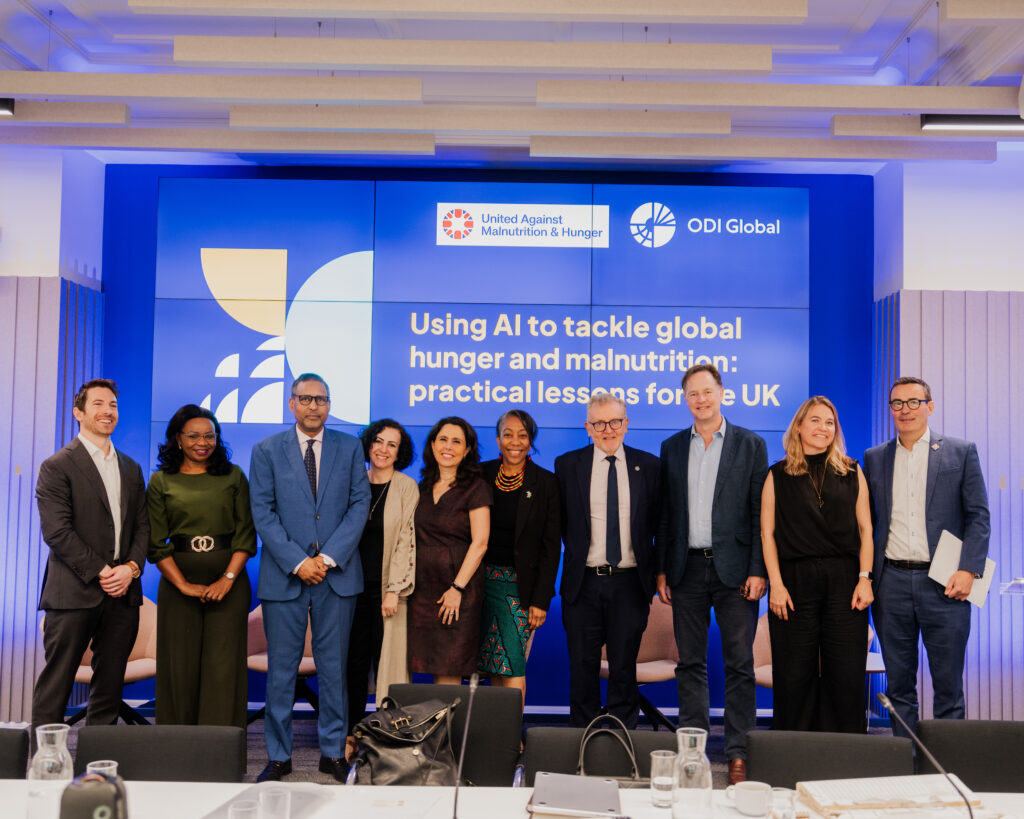
Against this backdrop, the session, Using AI to tackle global hunger and malnutrition: Practical lessons for policymakers, chaired by Sir Nick Clegg, former UK Deputy Prime Minister and President of Global Affairs at Meta and now a partner at tech fund, Hiro Capital, and convened by ODI Global and United Against Malnutrition & Hunger (UAMH), in partnership with the All-Party Parliamentary Group (APPG) on Nutrition for Development, brought together leaders from technology, business, civil society, diplomacy, and politics to explore how artificial intelligence (AI) and other emerging technological innovations can strengthen responses to global hunger.
ODI Global’s Chief Executive, Dr Sara Pantuliano, welcomed guests to their Headquarters at 4 Millbank, Westminster, positioning the session as a development-policy discussion about the approach policymakers need to take to ensure that responsible use of technology can achieve impact. Our Chief Executive, Jonny Oates, also provided opening remarks, stressing how malnutrition is entirely preventable and treatable, yet remains the underlying cause of nearly half of all deaths among children under five: “We think that’s wrong and we want to ensure that all the tools at the world’s disposal are deployed effectively and responsibly to fight it”, he said.
Speakers included Maryam Rezaei, Food Systems Lead at ODI Global, who set the scene, arguing that hunger is more complex, responses are often too slow, and technology can support earlier, better decisions. Maryam noted that technology cannot fix climate shocks but can change how decisions are made.
Dr Joy Kiiru, a member of the Jameel Observatory Advisory Group and senior lecturer at the University of Nairobi School of Economics, outlined how artificial intelligence can accelerate progress in tackling malnutrition through increased efficiency, data utilisation, and the use of biometrics to target those at risk while ensuring administrative accountability and increasing donor trust, sharing the example of the work of the Jameel Observatory of a machine learning tool to forecast acute child malnutrition.
Toby Norman CEO of Simprints, a non-profit technology company that develops ethical and inclusive digital identification systems, spoke about how ethical digital identity and AI-powered biometrics can help trace children through nutrition programmes ensuring they receive nutrition and health services, verify delivery, improve accountability, and target the right support.
Finally, Suzy Madigan, Founder of The Machine Race, a responsible AI consultancy and co-author of the UK-funded SAFE AI Framework, the first end-to-end operational governance model for the humanitarian and development sector, spoke about the conditions under which AI systems deserve our trust and, above all, the trust of affected communities: “Governance matters because of where AI is being deployed” she said, noting that 70 per cent of the world’s acutely food-insecure people live in fragile or conflict-affected places, often where food is weaponised. “You can’t take the politics out of hunger. And you can’t take it out of AI. What gets built, by whom, on whose data, under whose control: these are choices.”
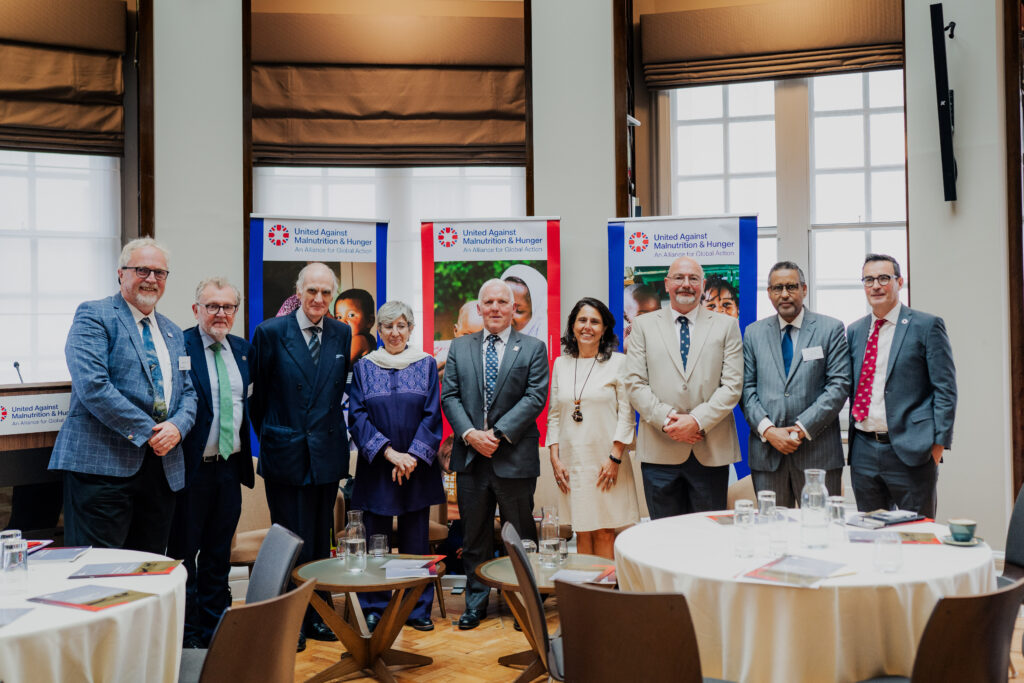
Joining the roundtable were a number of cross-party Parliamentarians including Alan Gemmell MP, Brian Mathew MP, Rt Hon David Mundell MP, Steve Race MP, Lord Bruce of Bennachie, Baroness Suttie, and Lord Mohammed of Tinsley. The High Commissioner from Zambia, H.E. Macenje “Che Che” Mazoka, and the Ambassador of the Federal Republic of Somalia, H.E. Abdulkadir Hashi also participated, with H.E. Mazoka noting that the UK is well-positioned to play a leadership role.
Reflecting on where the UK can add more value and on the role it can play, Sir Nick posited that it is only through developing technologies that can be used and which people actually need, that you can develop leverage and convening power. Giving the closing remarks, the APPG’s Co-Chair, Rt Hon David Mundell MP, expressed a hope that the session would be a catalyst for continued discussion in and around Parliament on the positive impacts of AI on development.