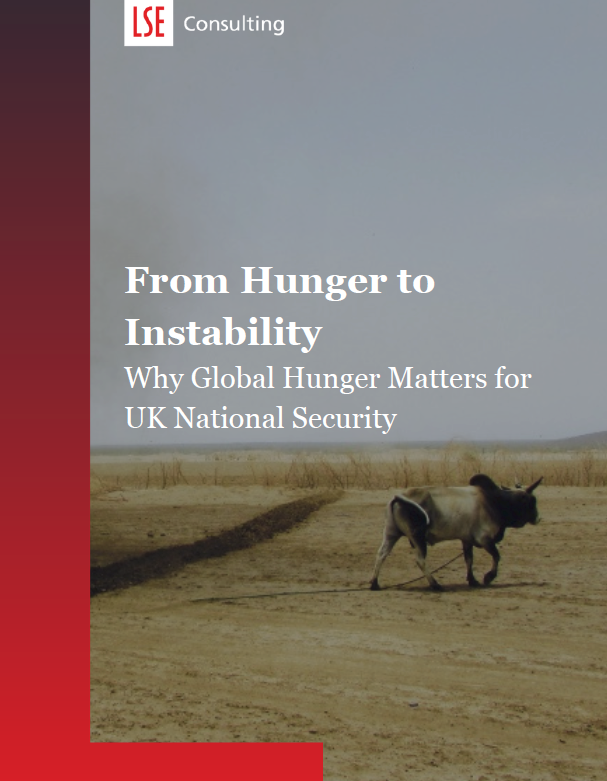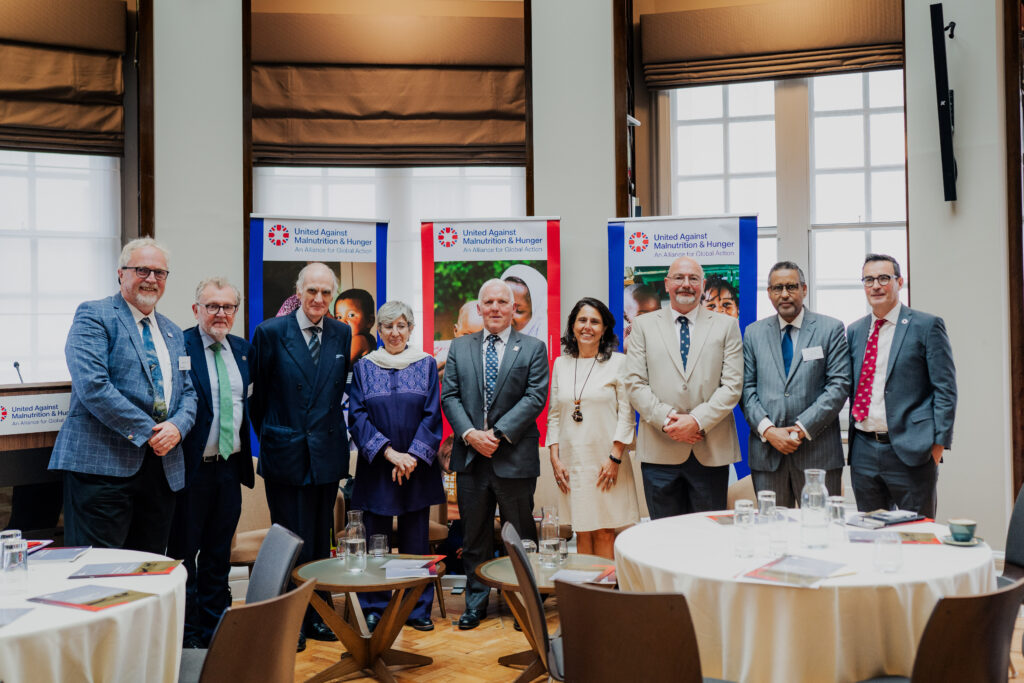
Parliamentarians, security experts, and sector leaders gathered at RUSI for the launch of UAMH’s report, From Hunger to Instability: Why Global Hunger Matters for UK Security.
Speakers at the launch of a new UAMH report at RUSI (Royal United Services Institute) warned that global hunger and famine are not distant humanitarian issues, but threats to security at home and abroad.
Commissioned by UAMH from LSE (London School of Economics and Political Science), From Hunger to Instability: Why Global Hunger Matters for UK Security presents evidence that malnutrition and hunger are both causes and consequences of conflict, and should be treated as humanitarian, health, development and national security concerns.
Expert speakers explained that food insecurity can function as a flashpoint for conflict, a threat multiplier, and an early warning sign of wider instability.
The keynote speaker, Lord Stirrup, former Chief of the Defence Staff and Marshal of the Royal Air Force, closed his speech by adapting words by John Donne, the poet, scholar and soldier born in 1571.
“The alarm bell is tolling urgently,” Lord Stirrup said. “And it tolls for all of us.”
He warned that the risks for the UK may only become visible once they are harder to manage.
“Hunger and famine don’t just happen to people far away and about whom we know nothing,” Lord Stirrup said. “They are threats to our own security here at home.”
He added that the report “sets out the problem clearly and makes compelling recommendations for dealing with it. But it is only action that will make a difference.”
The launch brought together cross-party Parliamentarians, security, development and humanitarian voices at RUSI. It was chaired by UAMH’s Expert Adviser Air Marshal (Ret’d) Sir Graham Stacey KBE CB, with contributions from Rosalind Roberts, Research Director, RUSI; Professor Stuart Gordon, the report author and former RAF and British Army officer; Dr Sara Pantuliano, Chief Executive, ODI (Overseas Development Institute) Global; and Dr Sima Samar, a medical doctor, former Vice President of the Interim Administration of Afghanistan, the first Minister of Women’s Affairs, and, from 2002 to 2019, Chairperson of the Afghanistan Independent Human Rights Commission and an Expert Adviser to UAMH.
Rosalind Roberts welcomed participants before Sir Graham set out why the report’s findings were urgent and practical.
“Global hunger and conflict are not an historical problem,” he stressed. “It is a real and current problem which we are running out of time to solve. This practical report offers ideas about the steps that need to be taken, what needs to be done and why.”
The report examined evidence from Tunisia, Somalia, Sudan, South Africa, Nigeria, Sri Lanka and Yemen to show how food insecurity can trigger or intensify political crises and conflict that extend beyond borders.
Its author, Professor Stuart Gordon, argued that hunger does not mechanically cause conflict, but can make corruption, inequality, and economic mismanagement visible in the basic transactions of daily life.
One example was Sudan in 2018, where an economic crisis, reduced bread subsidies and rising scarcity helped spark protests. Within days, demonstrations had spread across Sudan, and within four months President Al Bashir had been removed.
Professor Gordon described hunger as a “government stress test” and a security threat multiplier: it can erode government legitimacy, accelerate social mobilisation, and create opportunities for armed groups and coercive actors.
The report identifies warning signs including rising food prices, failed safety nets, disrupted markets, climate shocks, failed harvests, resource competition, and migration pressures. It argues that early anticipatory action is cheaper and more effective than responding after food crises have escalated into conflict, displacement, or wider regional instability.
In the discussion, Dr Sara Pantuliano said hunger should not be seen simply as a series of shocks, but as part of a structural interaction with systems. Food insecurity is about power, she said, and the severity of shocks varies according to governments’ capacity to respond, system resilience and the extent to which household indebtedness affects people’s ability to withstand crisis.
Dr Sima Samar’s observations underlined the tragic human consequences. Faced with hunger, people and communities become more desperate, she said, citing examples from Pakistan and Afghanistan of boys being brainwashed in Madrasas, joining the Taliban or being sold as child labour, and girls being sold as brides and sex slaves as young as nine to feed the rest of the family.
Sarah Champion MP, reflecting on her six years as Chair of the International Development Committee, said that while Official Development Assistance (ODA) had been cut, the military had been among the staunchest defenders of the aid budget. She said the report gave the IDC a robust dataset to take to the FCDO (Foreign and Commonwealth Development Office).
Monica Harding MP, Liberal Democrat International Development Spokesperson asked how departments within the reduced FCDO could be better integrated, how the connection with the public could be made, and what hope could be offered.
Dr Sara Pantuliano urged that conversations about ODA move beyond the 0.7% target to focus on what is done with the money: using it better, with greater attention to receiving countries, local solutions and a different type of engagement. That is where the country is at, she said.
Commenting on the wider political environment, Lord Stirrup said money had been moved from defence to health and social security, and that some of this needed to be reversed. Cutting the aid budget had been “an easy win”, but the wrong thing to do. In his opinion, 5.7% of GDP should be spent on defence, with 0.7% on development, and governments had to work out how to deliver it.
Steve Race MP, Parliamentary Private Secretary at the Ministry of Defence asked what a joined-up approach might look like. Lord Stirrup responded that the first question was how to know what is wrong in the first place, arguing for better intelligence sharing and upstream intelligence gathering, not only on military threats.
Sir Graham said that in operational theatre people spend a great deal of time on the ground, and that the simple question of who owns the problem must be asked. If that cannot be answered, he said, people cannot be surprised when the problem cannot be fixed; everyone needs to know their role. He too emphasised the importance of local solutions.
Geraldine O’Callaghan, London Director of the World Food Programme, observed that the structural problems and need for integrated solutions had been known since she worked at DFID (Department for International Development) in 2001.
She asked whether there had been conversations about incorporating aid into development. Lord Stirrup responded that there had not, and that “what we need to do is win the argument”. He added that it was very difficult to take money away from people, describing it as a political problem of the day.
From Hunger to Instability: Why Global Hunger Matters for UK Security argues that UK policy choices – including aid predictability, financing design, diplomatic engagement and policy coherence – directly influence whether food crises escalate or are contained.
Its recommendations include expanding predictable and anticipatory financing so prompt action and resilience-building happen before crises escalate; integrating nutrition and food security into conflict prevention, diplomacy, development and defence planning; prioritising locally led responses and supporting domestic investment in nutrition and food systems, including debt-for-nutrition swaps and local supply chains; and protecting trade corridors, ports and markets as critical infrastructure in fragile environments.
Taken together, the launch underlined the need to treat hunger and malnutrition as indicators and drivers of instability, and to respond earlier through predictable funding and closer alignment between security, development and diplomacy.
There was consensus that hunger is one part of the security puzzle, yet, as David Mundell MP and Co-Chair of the APPG on Nutrition for Development lamented, it is not discussed enough in Parliament.
As Lord Stirrup said, although addressing hunger will not solve the security puzzle, failing to deal with it could make that puzzle impossible to solve.
UAMH’s CEO Jonny Oates closed the event by thanking everyone for coming and urging the conversations to continue.
Because, as Lord Stirrup warned, the alarm bell is already tolling.
Download the report here.