Partnerships were at the heart of the Global Partnerships Conference, co-hosted by the UK and South African governments — and that focus was echoed in our event in Parliament on the eve of the conference.
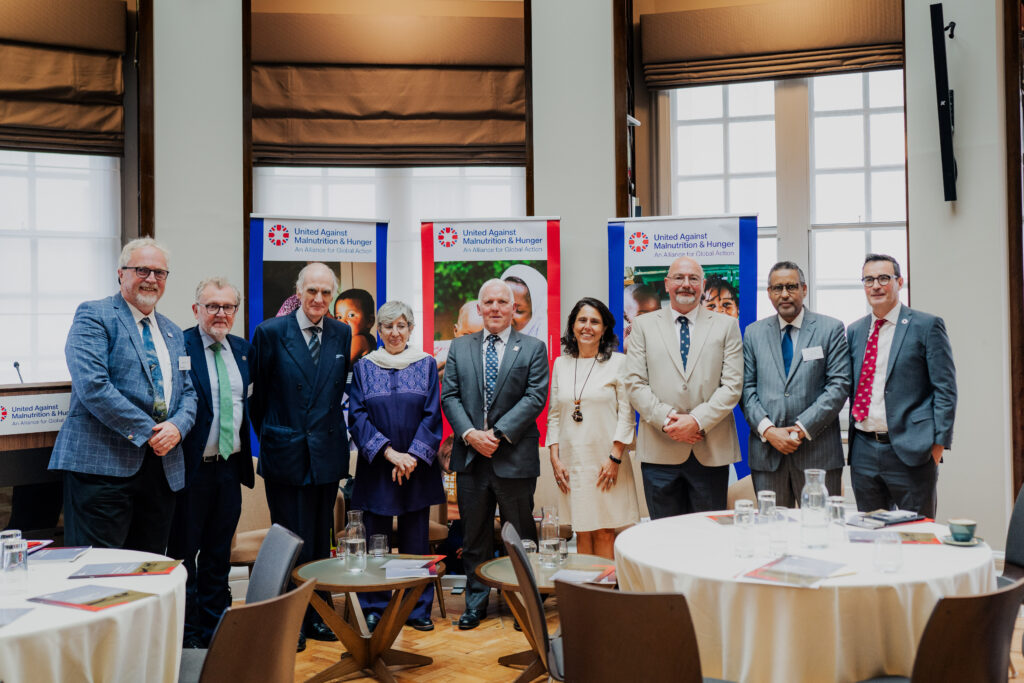
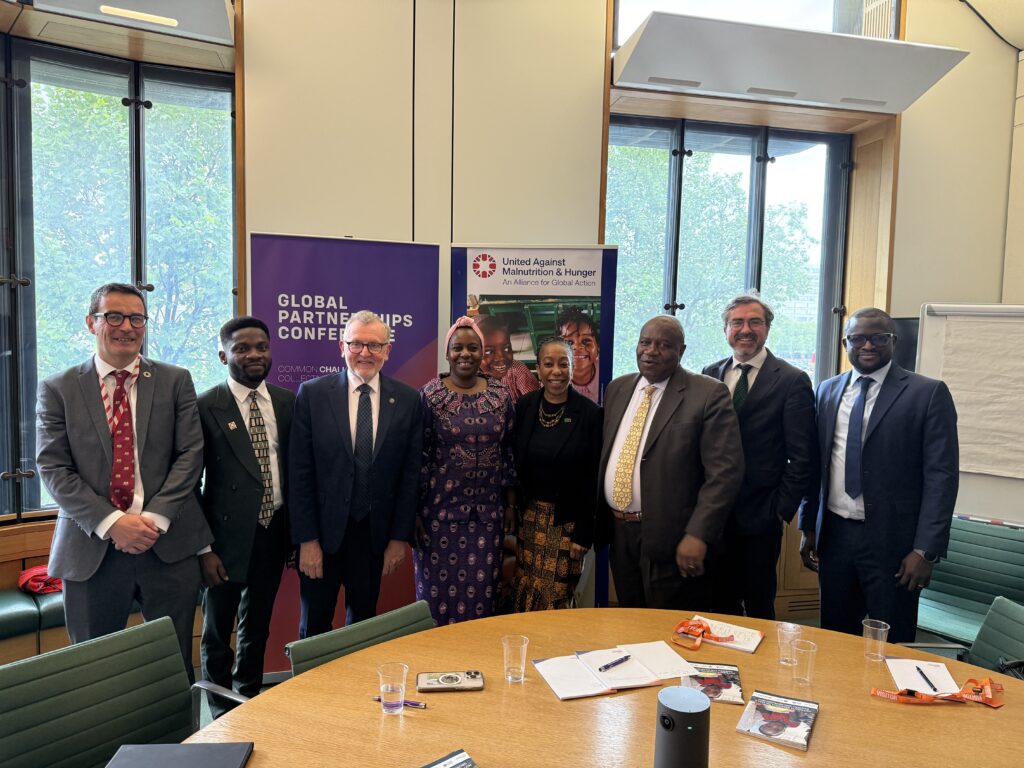
Partnerships for Tackling Malnutrition: Leadership & Lessons from Africa, convened by United Against Malnutrition & Hunger (UAMH) and the APPG on Nutrition for Development and chaired by its Co-Chair, Rt Hon David Mundell MP, brought together leaders from business, civil society, diplomacy and politics to discuss how stronger collaboration can help tackle malnutrition.
Speakers included UAMH Expert Advisers Neema Lugangira and Finian Ali; the South African High Commissioner to the UK, His Excellency Jeremiah Nyamane Mamabolo; the Zambian High Commissioner, Her Excellency Macenje Mazoka; and Deji Adebusoye, Partner at Sahel Capital. Together, they made the case for putting nutrition at the centre of a modern international development approach because, as His Excellency Mamabolo said, “It can never be acceptable that 45 per cent of child deaths are attributable to malnutrition.”
In his opening remarks, David Mundell emphasised the scale and impact of malnutrition, highlighting how it suppresses productivity, constrains economic growth, and disproportionately harms women and children across Africa. He said the challenge is too vast for governments alone and called for collective action across the private sector, philanthropy, NGOs, academia and policymaking to mobilise funding, expertise and political will.
Against a backdrop of declining Official Development Assistance (ODA) budgets in the UK and elsewhere, disproportionate cuts to nutrition funding in recent years, and stalled progress towards the Sustainable Development Goals (SDGs), the need for partnerships to deliver solutions is clearer than ever.
Good nutrition underpins development at every level. It is foundational to reducing poverty, generating growth and prosperity, improving health and learning, advancing gender equality, and supporting peace.
Neema Lugangira, a former MP in Tanzania, serves as Co-Chair of the Executive Committee of the Scaling Up Nutrition (SUN) Movement, which works across 66 countries. She said nutrition should be elevated at the conference and reflected in its outcomes, with financing, measurement and tracking built into integrated programmes and in-country delivery prioritised.
“When we invest in nutrition, we are saving lives, supporting stability, and shaping the future of nations. Surely that is the essence of this Global Partnerships Conference,” she said.
Deji Adebusoye picked up the theme of local delivery and solutions. Drawing on his experience of investing in Africa, he said private capital can strengthen diets from farm to plate. In practice, this means backing raw material producers, food processors and storage facilities, while also supporting smaller, community-based businesses with technical assistance, training and governance.
Speaking from lived experience, our Expert Adviser Finian Ali urged attendees to read his profile on UAMH’s website, which explains his personal connection to the issue. Now SUN Nigeria’s National Youth Coordinator and an expert witness at last year’s International Development Committee inquiry on Nigeria, he told attendees that as a boy he was frequently hungry and sometimes begged for food.
“It was terrible,” he told attendees — an experience so searing that even now he never finishes a plate of food, instead saving a portion for later.
Finian escaped hunger, but two decades later many children still do not. More than two million die from malnutrition each year. Millions more are left with lifelong physical and cognitive impairment.
That is why Finian is a strong advocate for the Child Nutrition Fund (CNF). Established in 2023 by UNICEF with support from the Gates Foundation, the Children’s Investment Fund Foundation (CIFF) and the UK Government, the CNF is an innovative financing mechanism designed to tackle stunting, wasting and anaemia in women and children. By combining ODA with contributions from business, philanthropy and high-burden governments, it helps UK funding go further and faster.
Finian called on the UK Government to support the CNF because “it is not charity. It is partnership that works.”
Her Excellency Macenje Mazoka spoke about the role of government in forging partnerships that protect nutrition. “Nutrition is not just a health issue, it is the foundation of human life,” she said. “If your belly is empty, it is difficult to sleep and to learn.”
Sadly, that is the reality for 30 per cent of children in Africa, whose growth is stunted by hunger. But Her Excellency stressed that this could change. “Governments set the policy frameworks to bring together actors across agriculture, education, social protection and local government so they are aligned to produce better nutritional outcomes for each child. It must be a collective approach.”
The speeches were followed by contributions from Alan Gemmell MP, Marion Yun from the World Food Programme, Alexandra Newlands, SUN Movement Civil Society Network, and Caroline Staffell-Mwangi from GAVI, the Vaccine Alliance. Our CEO, Jonny Oates, said the conference and the CNF were positive examples of international development partnerships in action and urged the UK Government to sustain its support for the fund.
Several speakers also highlighted the high debt burdens facing many African countries, which swallow government income that could otherwise be used to address malnutrition. They urged the UK Government to show leadership and consider innovative solutions such as debt-for-nutrition swaps.*
As David Mundell wrapped up proceedings, attendees agreed they hoped the Global Partnerships Conference would mark the start of a genuine commitment to international development — one where ambitions do not remain on paper but deliver meaningful change.
As Her Excellency Macenje Mazoka urged, nutrition should be a test of whether this new partnership agenda is truly working. “If it can help our children grow well, our mothers stay healthy and our communities become more resilient, we are not only addressing nutrition but building stronger societies and more stable economies. Zambia looks forward to having deeper, meaningful and structured partnerships that deliver for people,” she said.
Achieving truly equal global partnerships means confronting the inequality caused by malnutrition.
*Debt and Malnutrition: Ending the Doom Loop, a report from United Against Malnutrition & Hunger (UAMH), highlights a troubling doom loop between rising sovereign debt and worsening malnutrition in low- and middle-income countries (LMICs). In 2023 alone, LMICs allocated more than US$400 billion to debt repayments, more than they invested in social services like health and education. Read the report here.