Written by UAMH Board member and former MP in Tanzania, Hon. Neema Lugangira
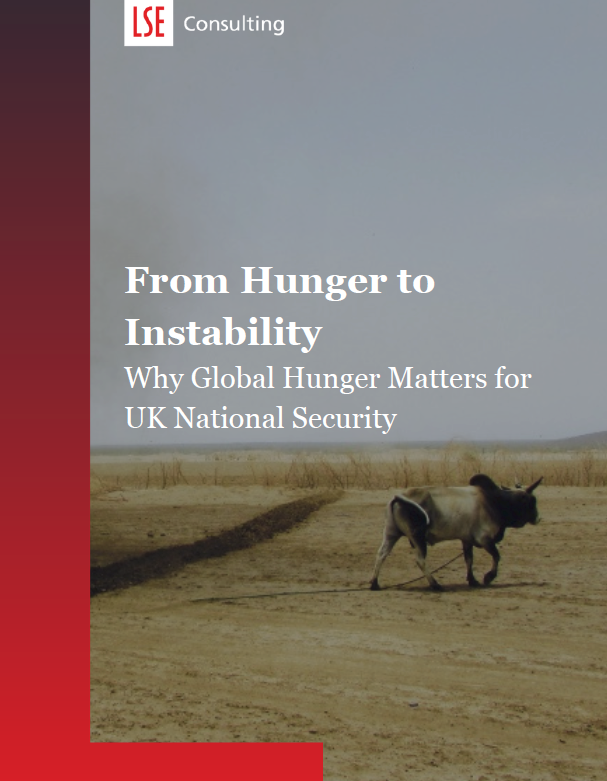
A recent report commissioned by United Against Malnutrition & Hunger (UAMH) and authored by Professor Stuart Gordon of the London School of Economics and Political Science (LSE) makes an important connection: hunger and malnutrition are both consequences and causes of conflict and instability. From Hunger to Instability: Why Global Hunger Matters for UK Security illustrates how food insecurity can deepen grievances, erode trust, intensify economic shocks and become an early-warning signal of wider political instability.
That argument matters for Britain. It means hunger belongs not only in humanitarian and development discussions, but also in conversations about resilience, prevention and security.
For me, this debate is particularly timely.
I first became involved with United Against Malnutrition & Hunger as an Expert Adviser and, just last week, was unanimously confirmed as a new member of its Board. Having also served as a Member of Parliament in Tanzania and worked through global and continental parliamentary networks, I have seen first-hand how decisions made in international institutions eventually arrive in national parliaments as questions of budgets, legislation, oversight and accountability.
I have also seen how consequential the United Kingdom can be in shaping the global nutrition and development agenda.
In May 2026, I was invited by the then Minister for International Development and Africa, Baroness Jenny Chapman, to participate in the Global Partnerships Conference in London, co-hosted by the UK and South Africa. The conference was explicitly designed to rethink the UK’s approach to development around partnership, local leadership, fairer finance, technology and shared responsibility. Baroness Chapman argued that development should be understood as an investment in shared global stability, not an optional moral luxury.
Later that month, I joined the official UK parliamentary delegation to Rome Nutrition Week through United Against Malnutrition & Hunger, which serves as the Secretariat to the UK All-Party Parliamentary Group on Nutrition for Development. That experience reinforced for me the influence parliamentarians can have when they are connected directly to global nutrition institutions, evidence and policy processes.
Yet when I began following the leadership campaigns for some of the world’s most consequential multilateral institutions, I saw a gap.
Governments and diplomatic missions were closely engaged. Candidates were making their cases to capitals and Member States. But parliamentarians, who would later be expected to legislate, approve budgets, scrutinise implementation and represent citizens affected by the decisions of those institutions, were largely outside those conversations.
That gap led me to establish the Africa Parliamentary Community Consultations.
We began with candidates for United Nations Secretary-General, Rebeca Grynspan and H.E. Amb. Carolyn Rodrigues-Birkett.
The questions raised by African parliamentarians demonstrated immediately why food insecurity and nutrition cannot be separated from wider questions of peace, humanitarian response and global governance.
Parliamentarians asked about conflict prevention, humanitarian crises, civilian protection and women’s meaningful participation in mediation and peace negotiations.
These are not distant diplomatic questions for families facing hunger.
Conflict disrupts agricultural production and food markets. It displaces communities. It restricts humanitarian access. It closes schools and interrupts children’s access to nutrition and health services. Women are often central to household food security and community resilience, yet remain underrepresented in the very peace processes that determine how societies recover.
The LSE-UAMH research highlights the other side of this relationship too: hunger itself can intensify political and economic pressures and contribute to instability.
The consultations then expanded to the FAO Director-General process, beginning with H.E. Amb. Josefa Sacko, with two further candidate consultations planned.
Here, parliamentarians moved directly into the politics of food security.
They asked how countries could prepare for climate shocks such as El Niño before those shocks became food shortages. They raised women’s and smallholder farmers’ access to land, finance and productive resources; youth participation in agriculture and food systems; child nutrition; post-harvest losses; and whether Africa could move from dependence on food imports towards becoming a stronger producer, intra-African trader and exporter of food.
They also challenged inconsistencies and restrictive phytosanitary requirements affecting African agricultural exports, raising the wider question of whether parts of the international food-trade architecture can place African producers at a structural disadvantage.
Behind these very different questions was one common concern:
How does global policy become national resilience before crisis arrives?
That question is especially relevant to Britain now.
The new Minister for International Development and Africa, Kirsty McNeill, has brought to the role a strong development background and has already framed the challenge in broader terms than traditional aid. In her first major speech in the role, she spoke of a world shaped by conflict, competition and environmental pressures and argued for a new approach based on how countries learn to live and work together.
That direction follows naturally from the UK Global Partnerships Conference, where Britain itself argued for moving beyond top-down development relationships towards equal partnerships, local leadership and shared responsibility.
But if partnership is to become more than a diplomatic phrase, parliaments need to be part of it.
As a new UAMH Board Member, one area I hope to help strengthen is direct dialogue between parliamentarians from donor countries and parliamentarians from countries where hunger, malnutrition, climate shocks and humanitarian crises are most acutely experienced.
A British MP scrutinising development spending and an African MP confronting drought, food-price inflation, displacement or child malnutrition may approach the same global system from very different political realities.
Both perspectives matter.
Bringing them together could improve understanding of where international financing is working, where implementation is failing, what national political constraints exist and which interventions actually strengthen resilience.
This is particularly important for Britain because its international influence extends far beyond development finance. As one of the five permanent members of the UN Security Council, the UK has a formal role at the centre of the multilateral system. It also remains influential across humanitarian response, global health, nutrition, international finance and food security.
That influence should be exercised not only after crises erupt, but earlier.
Britain should be asking who is seeking to lead the major institutions responsible for global food security, humanitarian response and development, what those candidates understand about implementation, and whether they are listening directly to the parliamentarians who will eventually have to turn global ambitions into national results.
The UAMH-commissioned LSE report makes the case that food insecurity can provide an early warning of instability.
African parliamentarians are providing another kind of early warning: that international commitments will continue to fall short if global decision-making remains disconnected from the national political institutions responsible for implementation.
Britain has both the standing and the experience to help close that gap.
And as the next global food crisis approaches, listening earlier may matter just as much as responding later.