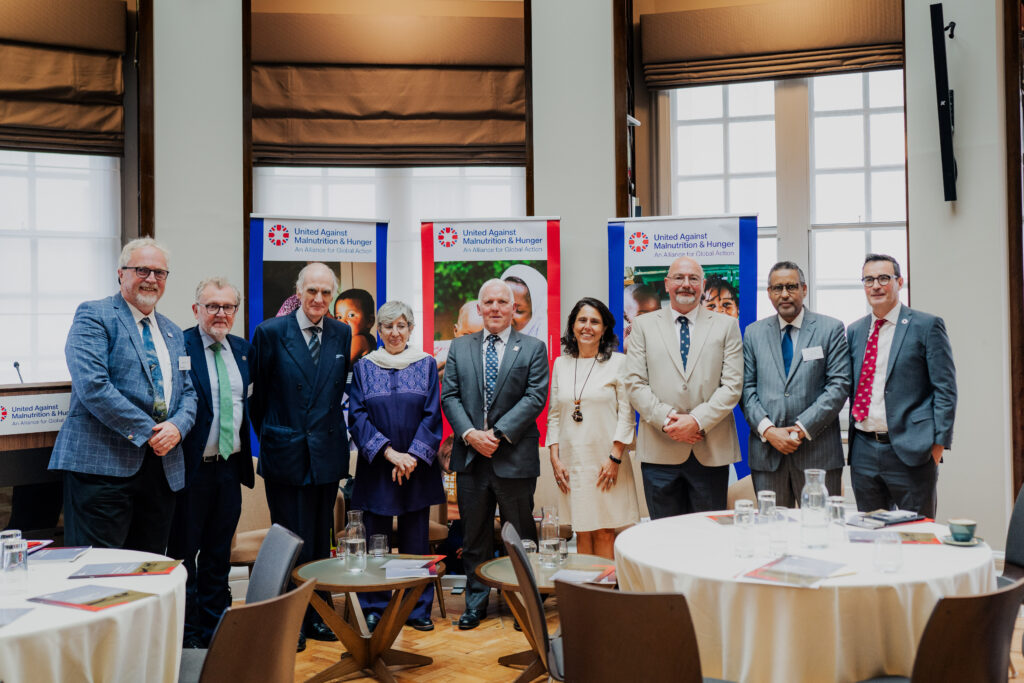
Reading University has a deep history of agriculture and food research and its leafy campus was the backdrop for a visit this month by the Rt Hon David Mundell MP, Co-Chair of the APPG on Nutrition for Development, and UAMH CEO Jonny Oates. Held during the university’s centenary year, the visit brought parliamentarians, researchers and advocates together to explore how evidence can help shape stronger action on global nutrition.
The delegation met researchers working across food systems, nutrition and healthy, sustainable diets. Shared learning was the aim of the day with Professor Giacomo Zanello, Professor in Food Economics and Health, Head of the Agri-Food Economics and Marketing Department, and UAMH’s newest Expert Adviser, emphasising colleagues’ interest in understanding how parliamentary perspectives could help guide future research priorities.
Professor Zanello had recently returned from Rome Nutrition Week, where the Global Nutrition Report, which he co-authored, was launched. The visit to Reading therefore built on recent international discussions about the scale of the nutrition crisis and the need for research-led solutions.
Reading is pioneering innovation in agrifood research, taking a multidisciplinary approach to understanding and improving the global food system and the diets it supports. The challenge is considerable.
Nutrition is foundational to health and development, yet malnutrition remains the biggest killer of children under five. For almost half the world’s population, a healthy diet is unaffordable, and current projections point to 600 million people facing hunger by 2030, driven by conflict, climate change and economic shocks.
Together, these pressures show that the global food system is failing to nourish people while also degrading the natural resources on which future food security depends.
The encouraging news is that UK research, including work at Reading, is challenging that trajectory. UAMH, an alliance of leading cross-party and cross-sector voices, is committed to championing evidence-based solutions to global malnutrition and connecting them with parliamentarians.
Jonny Oates reflected on the importance of bringing research and politics together and referred to his recent participation in the APPG delegation to Rome Nutrition Week alongside David Mundell.
David Mundell explained that the APPG’s purpose is to keep global nutrition on the parliamentary agenda and ensure members can hold government to account. “I am committed to trying to ensure that the Global Nutrition Report secures parliamentary engagement,” he said.
The visit began with a panel meeting chaired by the university’s Vice-Chancellor, Professor Robert Van de Noort, who emphasised Reading’s role in shaping the future of farming and nutrition. “We want our research to have real-world impact,” he said, describing the goal of healthier, more sustainable diets, including people eating more pulses and less meat.
The university’s Integrated Research and Innovation Farm acts as a large living laboratory, enabling researchers to test and demonstrate agrifood innovation. As Professor Lisa Methven, Associate Pro-Vice-Chancellor for Research (Agriculture, Food and Health), and Professor Simon Mortimer, Head of School of Agriculture, Policy and Development, explained, the vision of Agrifood Futures is for everyone to be able to consume a sufficient, healthy and sustainable diet that leaves the lightest possible footprint on the planet.
Professor Methven stressed that understanding the interconnected nature of the global food system is essential for predicting unintended consequences. Agrifood Futures focuses on three linked priorities: resilient food systems for everyone; farming systems that work with nature and climate; and food that nourishes people and the planet. Its multidisciplinary work brings together social, economic and environmental scientists exploring issues including pest control, greenhouse gas emissions, food waste and microbial foods, alongside basic, clinical and industrial science to support the path from discovery and testing to delivery and impact.
Professor Carol Wagstaff, Professor of Crop Quality for Health, spoke about her work to improve food system equity, including research with cash-strapped communities and the strong return-on-investment case for nutrition research: better diets support better health.
Professor Henny Osbahr shared research in India and Bangladesh challenging the conventional narrative on natural farming where farmers are improving soil health to achieve higher crop yields.
Weather concerns farmers across the globe, but Professor Emily Black, Professor of Terrestrial Processes and Climate, emphasised that farmers in the Global South are especially dependent on variable weather and need more accurate forecasting. Planting at the right time can increase yields by 10%, while access to insurance, often through commercial seed companies, can enable farmers to take more productive risks, she said.
Professor Zanello discussed research into the double burden of malnutrition among farming communities carrying out high levels of physical labour and consuming insufficient nutrition. He also spoke about work exploring locally produced formulations of ready-to-use therapeutic food (RUTF), including chickpeas in Ethiopia and soya beans in Nigeria.
Concluding the panel discussion, Professor Parveen Yaqoob OBE, Deputy Vice-Chancellor and Pro-Vice-Chancellor for Research and Innovation highlighted how the university invests in partnerships with the aim of achieving policy impact. David Mundell welcomed this focus, stressing the need to communicate how nutrition research benefits both the UK and the wider world, particularly in the context of reduced public support for international development.
The delegation then toured the university’s food processing plant, where Professor Colette Fagan from the Department of Food and Nutritional Sciences introduced the state-of-the-art facilities used for research into food processing technologies, quality and safety. One of the innovations is boosting the nutrition of white bread with broad bean fibre. Afterwards, the group was treated to a sustainable, nutritious and tasty buffet lunch.
Prepared by the catering team, the lunch featured dishes from the Menu for Change initiative, reflecting the university’s commitment to embedding health and sustainability across its food provision.
By the end of the visit, participants agreed it had delivered plenty of food for thought and a strong appetite for continued collaboration.