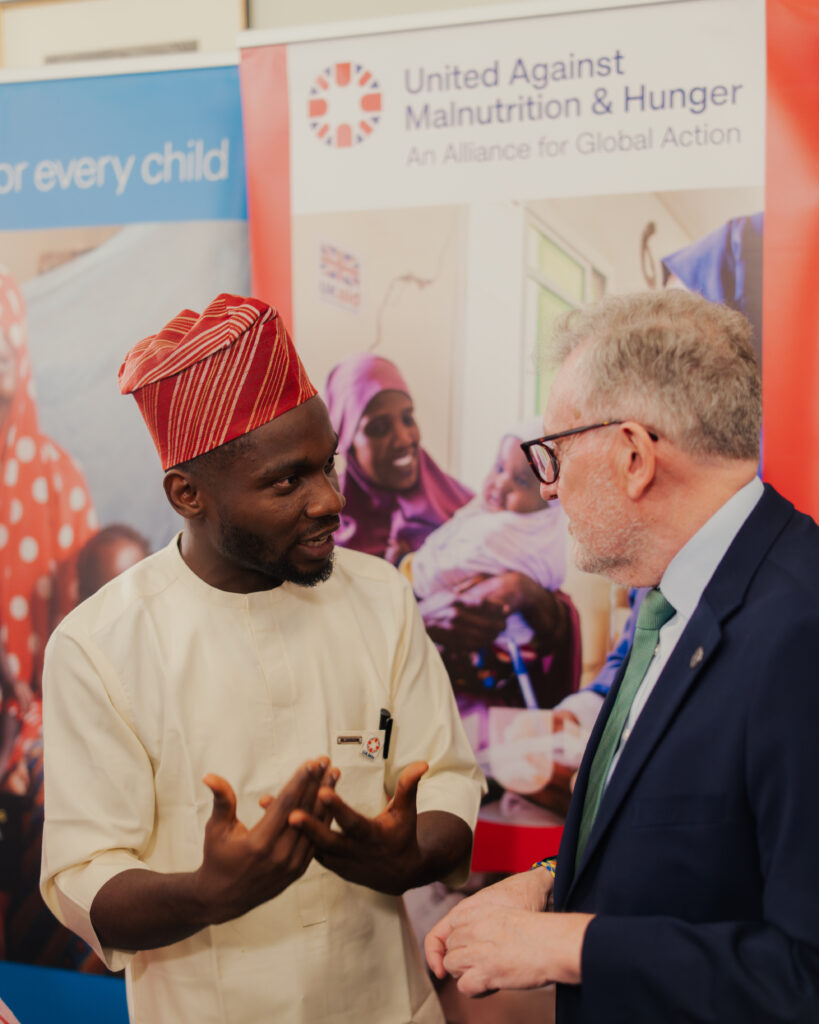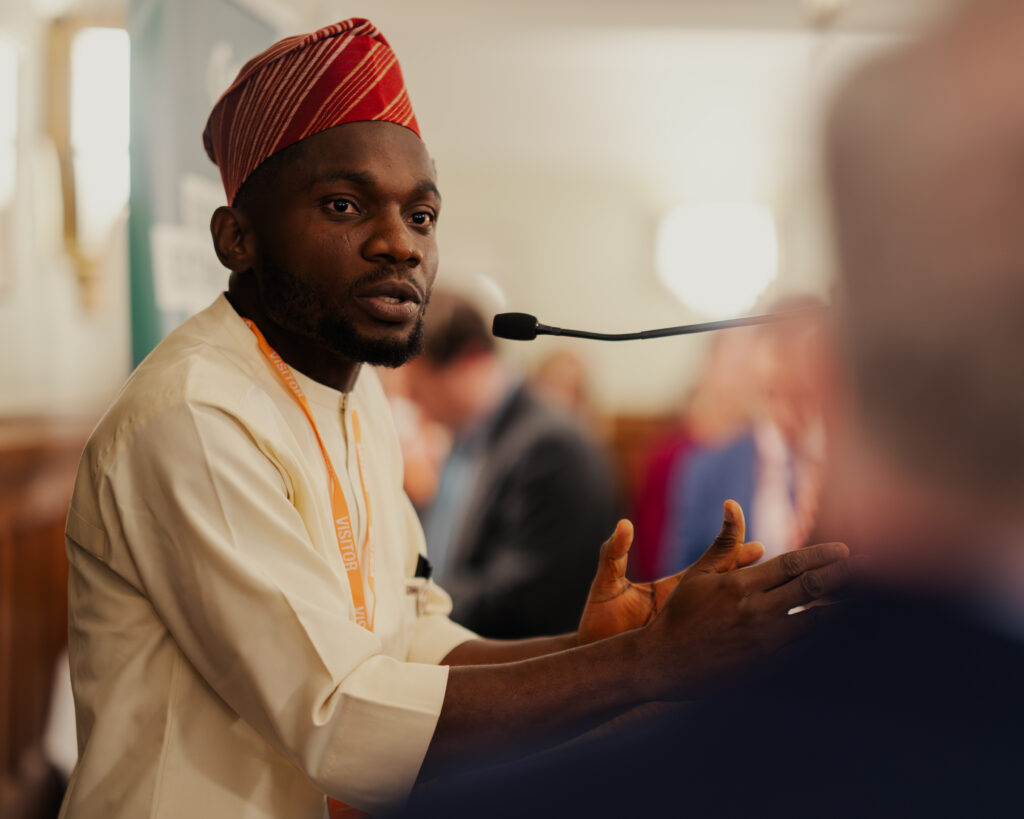
Finian Ali is wired up differently from most people in the UK. Even now, he rarely finishes a meal, instinctively setting portions aside for later. The experience of childhood hunger — both physical and psychological — still shapes his personal and professional life at 32. It led him to join United Against Malnutrition & Hunger as an Expert Adviser.
Finian was nine years old, attending primary school in Lagos, Nigeria, when his mother died. A businesswoman and the family’s breadwinner, her loss triggered an abrupt and devastating change in his life. The youngest of eleven children in a polygamous family, Finian was taken from the city he loved to stay with his grandmother in rural village.
The years that followed were marked by instability. He lived with seven different families, frequently hungry and sometimes begging for food. “I missed the city and the sense of safety I had in my family home,” he recalls. “I felt powerless — and constantly exhausted from hunger.”
Describing himself as self-motivated, Finian refused to be defeated. He found ways to survive, shelling nuts, farming for people, and making brooms from palm leaves to pay for school fees.
By fifteen, he was living alone in a small room at his school, surrounded by pots and plates, but often with nothing to cook. “I knew education was my way out,” he says. “I was curious, and I wanted to understand why others had so much — and how I could create a better life for myself.”
He became the first in his family to successfully complete a university education and earn a bachelor’s degree, a journey made possible through a combination of personal sacrifice, hard work, and support from individuals who recognised his resilience and ambition. While studying, he began volunteering with student groups, including one tackling gender inequality. It was transformative.
“I come from a society with strong gender roles. University opened my eyes. I realised women can be leaders — and that equality makes everything better,” he says.
After graduating at 24, Finian joined Scaling Up Nutrition (SUN) as a youth advocate — a global network spanning more than sixty countries, committed to ending malnutrition, still the leading cause of death among children under five.
“I was proud to join an organisation working on an issue I felt so connected to,” he says.
He quickly progressed to become the SUNCSN (Scaling Up Nutrition Civil Society Network) National Youth Coordinator for Nigeria. In this role, he built the first and only SUN Youth Network in Nigeria, convened nutrition dialogues, and worked with policymakers and parliamentarians to push investment in maternal, infant and child nutrition — including expanding school feeding programmes and improving health worker training.
“Like many MPs in the UK, parliamentarians in Nigeria don’t always realise how foundational nutrition is,” he explains. “But with sustained engagement, they become very receptive.”
Despite his early experiences, Finian considers himself fortunate. He received essential nutrients during the first 1,000 days of life — from conception to age two — a critical window for physical and cognitive development. Without that nutrition, damage and disadvantage can be permanent.
That understanding fuels his commitment to the Child Nutrition Fund (CNF), which is scaling up rapidly in Nigeria.
Established in 2023 by UNICEF, with support from the Gates Foundation, the Children’s Investment Fund Foundation (CIFF), and the UK Government, the CNF is an innovative financing mechanism designed to tackle stunting, wasting and anaemia in women and children — red flags indicating malnutrition.
The fund’s huge ambition reflects the scale of the challenge: to reach 70 million pregnant women annually with supplements and counselling, 230 million children with preventive services such as vitamin A supplementation and deworming, and 20 million children with life-saving treatment — with a 2030 deadline.
Its ingenuity lies in its three-pronged funding approach, designed to respond to malnutrition in emergencies while facilitating long-term systemic change. In practice, this means: funding to scale up and deliver evidence-based nutrition programmes; funding to encourage governments in countries affected by malnutrition to invest in their own nutrition services by matching their contributions; and funding to produce and supply life-saving treatments locally, such as ready-to-use therapeutic food (RUTF) for children and multiple micronutrient supplements (MMS) for pregnant women.
“Every contributor to the CNF becomes a partner and shares in its progress,” Finian says. “I’ve seen first-hand the difference it makes in Nigeria.”
At a time when partnership sums up the UK Government’s approach to international development, the CNF is a clear example of collective action in practice.
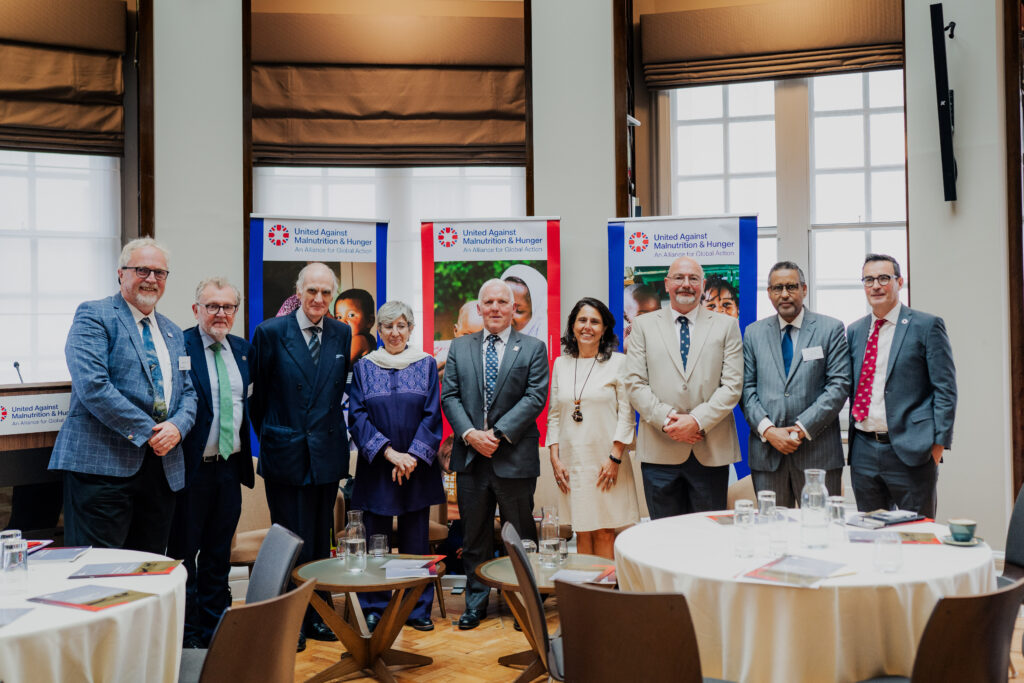
A point, no doubt, Finian will be making at the Global Partnership Conference co-hosted by the UK and South Africa in London next week. UAMH is urging the UK government to show partnership in action at the conference by disbursing the remaining £8m of the £16m it pledged to the CNF in 2023.
Worldwide, more than two million children die from malnutrition each year. For those who survive, the health, physical and cognitive harms can last a lifetime — and hold back countries and economies. The Child Nutrition Fund offers a powerful opportunity to change that. By combining taxpayers’ money with contributions from multiple partners, it helps stretched UK official development assistance (ODA) go further and deliver a stronger return on investment.
Malnutrition is preventable and treatable — but action requires both funding and political will. Because malnutrition and hunger are root causes of poverty — driving discontent, unrest, conflict, and migration — failing to act is far more expensive overall.