Nearly 70% of the British public want the UK Government to collaborate with international organisations like the World Bank to reduce debt repayments for low-income countries—if it enables greater investment in children’s nutrition, education, and healthcare.
Polling of 2,122 UK adults by Focaldata shows strong cross-party backing : 83% of Labour, 69% of Liberal Democrat, 64% of Conservative, and 59% of Reform UK supporters agree this is the right course of action. Support is especially high among younger voters, with 78% of 25–34-year-olds and 76% of 18–24-year-olds backing UK leadership on the issue.
Jonny Oates CEO of United Against Malnutrition & Hunger (UAMH), which commissioned the research, said: “As political parties compete for the attention of younger voters, debt is clearly an issue they care about and want to see action on. Leaders should take note.”
The findings accompany the launch of Debt and Malnutrition: Ending the Doom Loop, a new report from UAMH, which highlights a troubling doom loop between rising sovereign debt and worsening malnutrition in low- and middle-income countries (LMICs). In 2023 alone, LMICs allocated more than US$400 billion to debt repayments, more than they invested in social services like health and education.
The report, commissioned from Informed International, found that as debt repayments rose, nutrition programmes shrunk, increasing vulnerability to illness, poor health, and premature death. The foundational nature of nutrition to economic and social development, make these findings particularly alarming, with malnutrition impacting health, learning and productivity. Because malnutrition damages the brain, body, and immune system of each person, it holds back entire countries and their economies and can drive instability and conflict.
Between 2010 and 2023, in the nine LMICs analysed, sovereign debt surged by 250% and debt interest payments tripled compared to government revenues, corresponding with rising malnutrition and hunger. By 2023, one in five people were malnourished, two in five women of reproductive age were anaemic, and one in three children under five were stunted. The report also clearly shows that higher nutrition Official Development Assistance (ODA) correlates with stronger domestic investment by LMICs in their essential services which reduces rates of malnutrition.
The report reveals an increase in the proportion of debt owed to private creditors, often under costly, opaque terms, limiting access to transformative finance. It recommends key reforms to break the doom loop, and turn debt from a barrier to a driver of progress including:
- Protecting nutrition budgets during fiscal crises
- Ringfencing nutrition in ODA
- Promoting debt transparency
- Debt for nutrition swaps, linking debt relief to measurable nutrition outcomes
- Reforming debt sustainability assessments to reflect the impact of debt on nutrition.
With its global financial influence, the UK is well-placed to play a leading role in these reforms.
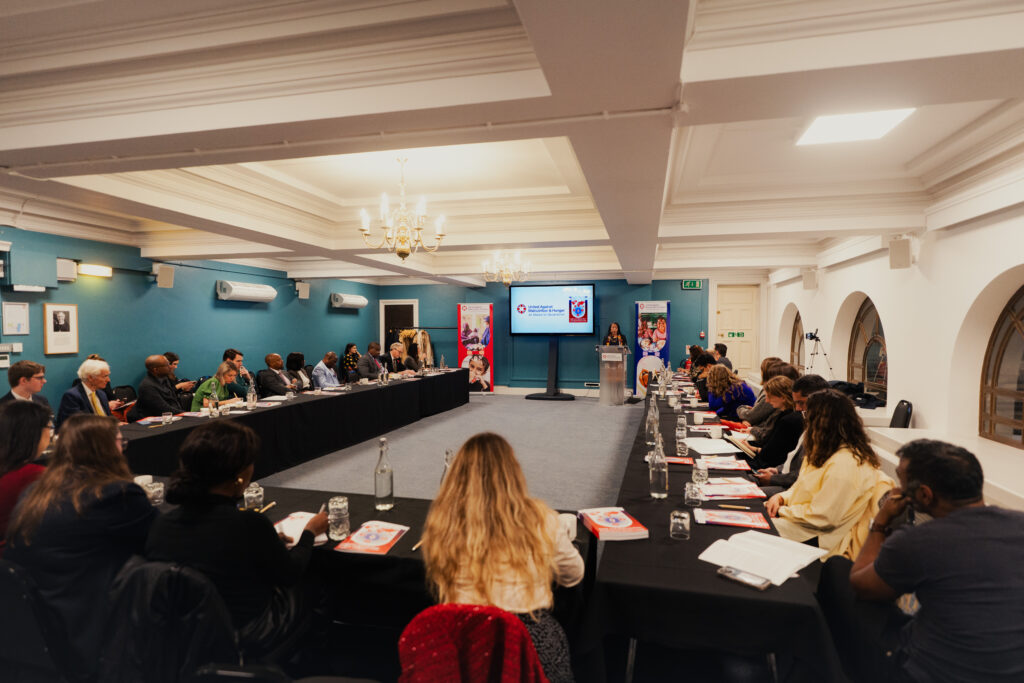
The report launched on 12 November, in Central Hall, Westminster, with a panel event chaired by Arunma Oteh, former Treasurer and Vice-President of the World Bank and current Chair of the Royal African Society.
Arunma Oteh said: “When a government is spending a large proportion of its revenue on debt servicing, of course, it cannot pay for adequate health, education, and transport services for its population. This burden of debt is responsible for the dire financial situation in many countries today, and the impact on families is heartbreaking.”
The panel also includes Her Excellency Macenje “Che Che” Mazoka, the High Commissioner of Zambia to the UK, the Rt Hon Liam Byrne MP, Chair of the Business and Trade Committee, and Jonny Oates, CEO of United Against Malnutrition &Hunger.
Jonny Oates said: “Our report presents concrete measures to address the current crisis. Declining ODA will detrimentally effect LMICs. So, it is essential that current nutrition-focused ODA is protected, and debt reform urgently addressed.
“These actions will help children survive and thrive, strengthen economies, and tackle the root causes of instability and conflict —goals aligned with the aspirations of young British voters. Leadership means action and the time for action is now.”
Notes
- Debt and Malnutrition: Ending the Doom Loop analysed secondary data from nine LMICs: Bangladesh, The DRC, Ethiopia, Kenya, Malawi, Nepal, Nigeria, Pakistan, and Sierra Leone. These countries are listed as flagship countries in the Foreign and Commonwealth Development Office (FCDO) Ending Preventable Deaths Strategy, transitioned to the Healthy Women, Children and Newborns strategy. The report compared the median data from these counties with data from the UK and Germany. Debt and Malnutrition: Ending the Doom Loop also conducted primary research in two case study countries Kenya and Pakistan
- Link to Debt and Malnutrition: Ending the Doom Loop Executive Summary