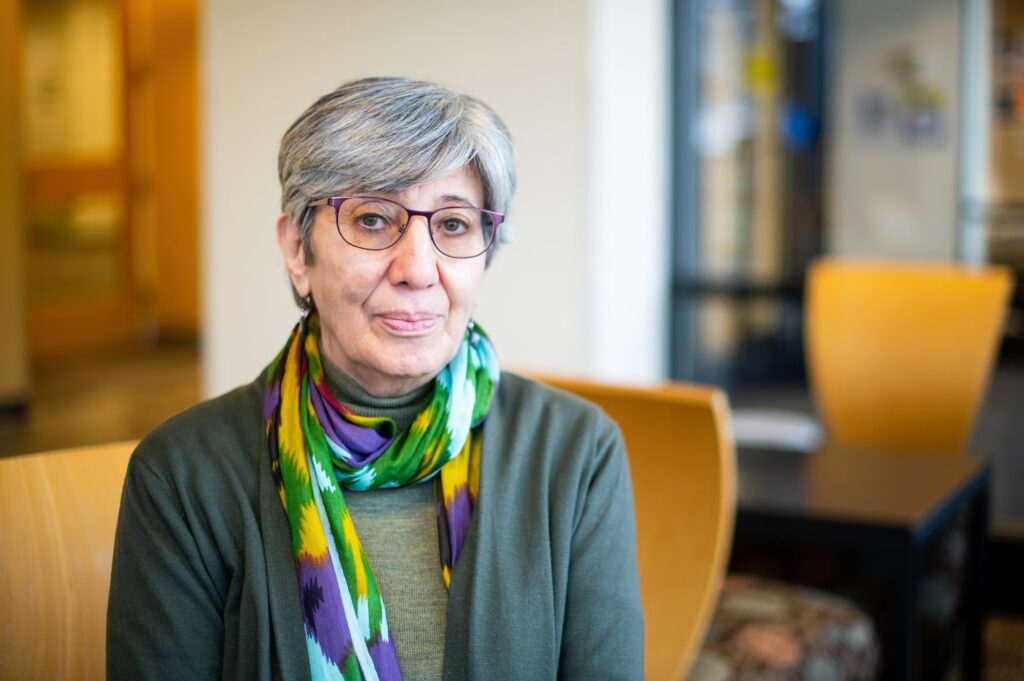
Nobel Peace Prize Nominee Dr Samar is overseeing the Persian version of her biography Outspoken. She hopes her life will inspire women and girls in Afghanistan and Iran to recognise their rights and pursue their freedom.
A life that has taken her from Jaghori, a mountainous region in Afghanistan, to Massachusetts where she is a visiting scholar at Fletcher School, Tufts University now.
Strong, she says, like most women in Afghanistan who have survived 48 years of war and conflict, she has always spoken her mind. As a young doctor in the country’s capital and rural areas. When setting up clinics, hospitals and schools in Afghanistan and Pakistan for Afghan refugees. And as Vice Chair and the Minister for Women’s Affairs in President Hamid Karzai’s cabinet where she received death threats from warlords opposed to women’s rights.
“Silence helps impunity. It helps continue the oppression of the rights of people,” she says, clearly a woman determined to make women’s voices heard.
These days, secondary education is forbidden for girls in Afghanistan. But Dr Samar attended school in Pre-war and Taliban days, wearing a skirt and socks, and graduated to medical school in Kabul. She was twenty-three, married, with a young son when the USSR invaded. Her husband was abducted, and she never saw him again.
Armed with a stethoscope, blood pressure machine, and medical textbook, she left Kabul for a rural area where she frequently walked for hours or rode a donkey to visit patients living in poverty. That is when her activism against malnutrition began.
She observed its impact—visible in women’s faces, hair, and eyes—and its connection to inadequate reproductive healthcare. Many women were chronically fatigued, anaemic, and miscarrying due to a lack of essential nutrients. “They were pale, with cracks on their skin and crooked nails because they were not getting enough quality food, oxygen and calcium.”
After contracting whooping cough, she sought an X‑ray in Pakistan, where she remained to treat Afghan refugees. She continued to see the same severe malnutrition in women and children and knew they needed attention, nutrition, healthcare, and education. In response, she founded the Shuhada Organization in 1989.
By 2001 it had grown into a network of four hospitals, twelve clinics and fifty schools in Pakistan and Afghanistan. “We had 1,200 teachers, mainly women who had reached sixth grade,” she explains. “We hired them as teachers for first grade, and taught them the science subjects, algebra, chemistry, and biology in the afternoons.” The organisation was funded by NGOs including Oxfam.
That same year, Dr Samar became Minister for Women’s Affairs, but her outspokenness drew opposition from warlords who pressured the President to remove her. She subsequently left the cabinet and established the Afghanistan Independent Human Rights Commission, where she served as Chair from 2002 to 2019. “There my voice could be louder because I did not have to censor myself and tow the government line,” she says.
As a UN Special Rapporteur for Sudan, she witnessed similar patterns of malnutrition. She promoted small, practical interventions—encouraging families to increase consumption of eggs and yoghurt, commonly available through household livestock. She also raised awareness of osteomalacia, a condition linked to calcium and vitamin D deficiency, often exacerbated by limited sun exposure. Her work earned her a Nobel Peace Prize nomination in 2009.
In 2021, while visiting her son and family members in the United States, the political situation in Afghanistan shifted dramatically as the Taliban regained power. She accepted an academic position at Harvard before moving to the Fletcher School.
Now a United Against Malnutrition & Hunger Expert Adviser, Dr Samar continues to advocate for Afghanistan from a distance. She urges the British government not to recognise the Taliban and to resist normalising human rights abuses under the guise of respecting local culture. She calls for support for targeted malnutrition relief and for strengthened reproductive healthcare programmes.
She warns that hunger fuels insecurity: when families cannot meet basic needs, children may be drawn to madrassas or militant groups, and adults may join extremist networks for survival. Malnutrition, she argues, has global consequences—including for the UK.
“If we deny there is malnutrition and hunger and do not pay serious attention to it, we will risk the security of everybody.”